Soil Testing & Amendment
Most lawn problems start in the soil, not the grass. A test tells you what it's short of, so every dollar after that lands where it counts.
- Know exactly what your soil needs
- Amend precisely — no wasted product
- A Lawn Health Report you can keep
Why a lawn can be fed all year and still go backwards
Grass does not absorb nutrients directly — the soil has to release them, and whether it can depends on pH. Get too far either side of the range and nutrients that are physically present in the soil become locked up and unavailable, no matter how much more you add.
So a lawn can sit in soil containing everything it needs and still be starving. People spend a year on fertiliser, see almost nothing, and conclude the lawn is beyond help. Usually it is one number out.
The Townsville problem specifically
Local soils are commonly sodic — high sodium relative to calcium and magnesium. Sodium makes clay particles disperse rather than clump, and dispersed clay is what sets hard, sheds water and seals over.
Under the topsoil, the clay layer runs strongly alkaline, around pH 8.5 to 9.6. That is why we core to 75–100 mm and no deeper: bring that up and spread it over the surface and you have made the problem worse.
Gypsum is the standard correction. It supplies calcium that displaces the sodium, so the clay flocculates and the soil drains rather than sealing — and unlike lime it does that without pushing the pH up further.
What a test actually tells you
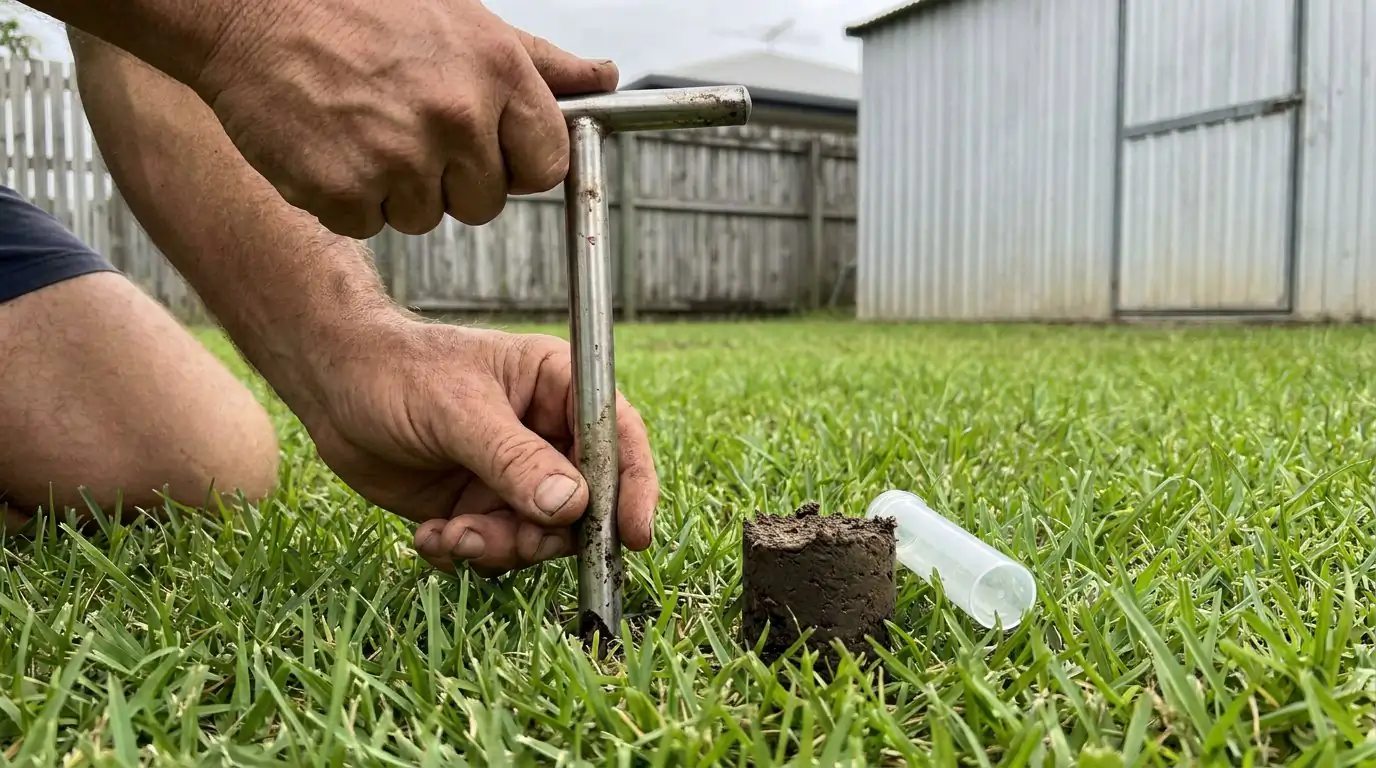
A proper lab panel reads pH in both water and calcium chloride, electrical conductivity, cation exchange capacity, exchangeable sodium percentage, and the individual nutrients. Together those say what the soil is holding, what it can release, and whether sodium is the thing wrecking the structure.
That turns lawn care from guessing into arithmetic. You stop buying products on a hunch and start correcting the one or two things that are actually wrong.
An on-site reading is not the same thing
A probe pushed into wet soil gives you a pH number for one spot at one moment. It is genuinely useful as a first look and it is what tells us whether a lawn is worth testing properly.
It is not a substitute for the lab panel, and we will not pretend it is. If we take a probe reading, we will tell you what it can and cannot tell you.
What happens after the results
You get the numbers and a written plan off them, in plain words: what is wrong, what fixes it, in what order, and what you can leave alone. Some of it you can do yourself and we will say so.
Where gypsum is the answer, that is $3 a square metre applied. Where it is not, we will tell you that too — gypsum on a soil that is not sodic is money spent on nothing.
What it costs
$350 for the full lab panel, sampled properly and sent to an accredited lab, with the written plan off the results.
It is included in the Green Lawn Program every year, and if you pay for the year up front it is the full lab panel rather than an on-site reading — a free upgrade worth the $350 on its own.
| Full lab panel + written planSampled properly, sent to an accredited lab, and read back to you in plain words. | $350 |
| Gypsum, appliedWhere the results say the soil is sodic. If they do not, we will tell you. | $3/m² |
| In the Green Lawn ProgramEvery year. Pay for the year up front and it is the full lab panel, free. | Included |
All prices AUD inc GST.
No payment to get a price.
Not happy? We come back and fix it — free.
We'd rather earn the next visit than argue about the last one. It's an extra promise on top of the rights you already have — our way of saying we back the work.
Want soil testing done properly?
Tell us about your lawn and we'll text you a price.